Back in 1946, long before I was born, this is what a computer looked like:
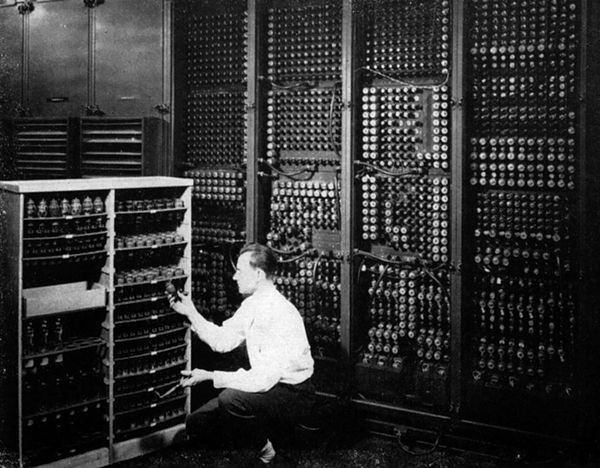
The cost of the ENIAC was around $8.4M (us dollars) equivalent in today's economy. Put side-by-side with a cheap feature phone from 2024, the progress is almost absurd:
| ENIAC | Nokia 105 4G | Comparison | |
|---|---|---|---|
| Memory | ~100B (decimal-digit equivalent) | 64MB (ram) | 640,000x |
| Price (usd) | $8,430,000 | $48.40 | 174,174x |
| Mass | 27.2 tons | 93g | 292,473x |
| Power usage | 150kW | 0.665W (active VoLTE call) | 225,564x |
In a span of 78 years (Nokia 2024 - ENIAC 1946), some of the measured metrics have improved by over 100,000×. In 1946, no one owned a pocket calculator because it didn't exist at the time, in 2026, ~84% of people aged 10 and over own a mobile phone.
What was once room-sized, enormously expensive technology can eventually become something almost everyone carries in their pocket. I'm admittedly biased toward local AI, but I think LLM inference is on the exact same trajectory.
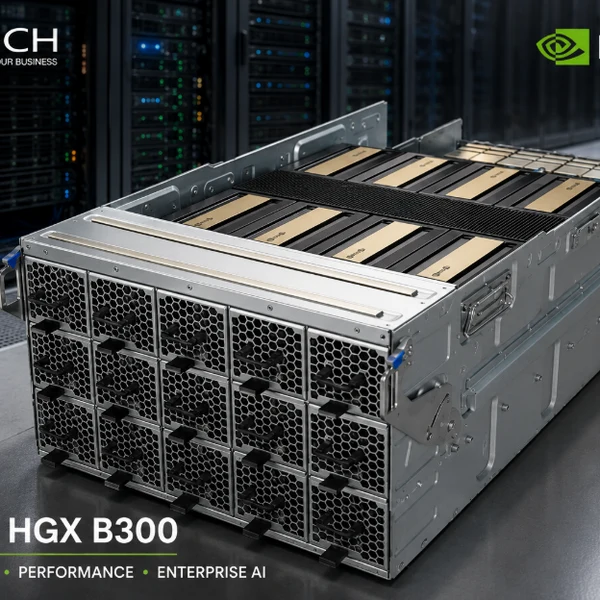
Current smartest open-weight model by benchmarks is Moonshot's Kimi K3.1 Pro, 2.8T parameters counting MoE, 104B active. It’s very close to the American frontier. NVFP4, a quantization made by Nvidia, achieves near-identical benchmark results to MXFP4, and its size is +1.6TB on disk. No consumer PC can run it (at usable tokens per second). Not even high-end modern $20 000 setups. An 8xB300 system capable of running the model costs hundreds of thousands of dollars.
Here's an image of it (reminds you of the ENIAC, doesn't it?):
But local AI doesn't have to cost that much, LFM 1.7B fits on a Raspberry Pi, GLM 5.3 Flash and Qwen 3.8 Flash-Next fit on some consumer hardware with quantization and using ram / ssd offloading with Strata or Maya. They’re amazing models, I truly appreciate them. People underestimate what percentage of tasks currently done by SOTA Claude and GPT models can already be done by local models. But there is still an undeniable, meaningful gap between them and the proprietary frontier at Anthropic and OpenAI or Kimi K3.1 Pro.
I personally think local superintelligence is a plausible future, I would highly prefer it over proprietary closed AI solely behind a few companies who can control censorship, propaganda and cost.
But something has to change drastically in order to make it viable. Those factors could be for example:
- Computers: better efficiency, more compute, lower cost
- Math: less expensive calculations, or more efficient calculations (e.g. faster algorithms)
- Better intelligence density / architecture: smarter models at way lower size
The question is if we want to fit today's AI on tomorrow's hardware, or tomorrow's AI on today's hardware. Or both.
Thanks for reading.